Integrated Crop Protection Program: Step by Step to Reduce Losses and Increase Efficiency

Using pesticides alone is no longer sufficient to protect crops from recurring infestations. True success is not achieved by increasing the number of spray applications, but by building an integrated crop protection program that starts with precise monitoring, moves through accurate diagnosis, and ends with evaluating results and adjusting the plan. This approach reduces losses, preserves pesticide effectiveness, and improves agricultural productivity over the long term
In this practical guide, we present clear steps to help you build a balanced and effective protection program.
First: What Is an Integrated Pest Management Program?
An integrated pest management program is a management system that combines:
Regular monitoring
Accurate diagnosis
Rational use of pesticides
Supportive agricultural and environmental practices
The core idea is to reduce random reliance on insecticides and make them part of a broader pest management framework.
Second: Monitoring and Diagnosis Stage
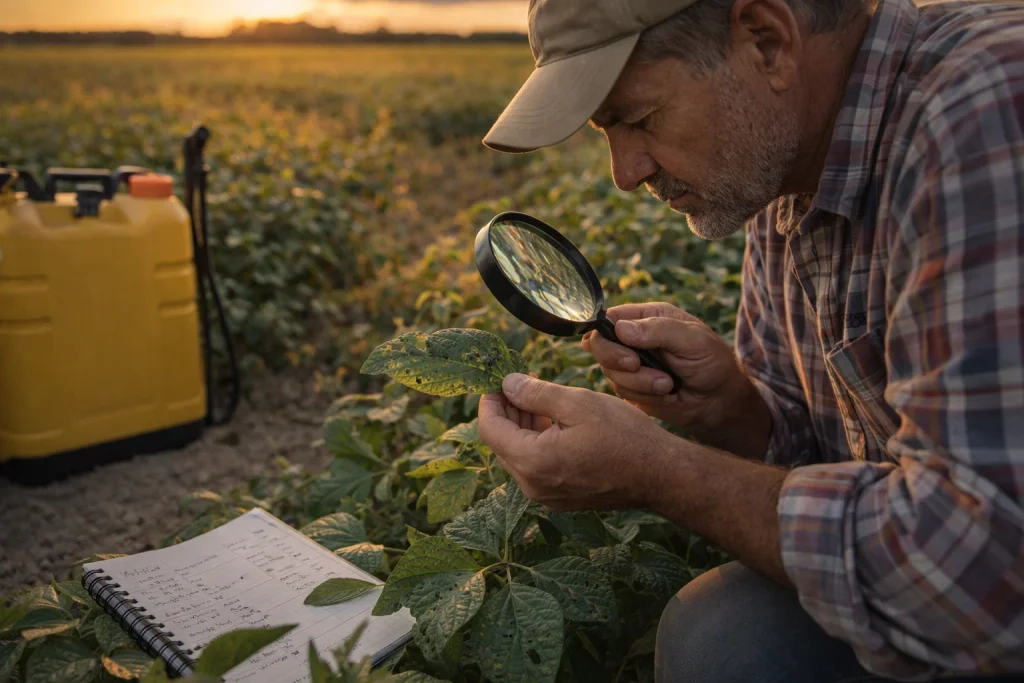
A successful program cannot be built without a precise understanding of the nature of the infestation. The first step is determining whether the problem is caused by insect and fungal infection or by environmental factors.
Diagnosis includes:
Inspecting both sides of the leaves
Evaluating the pattern of infestation spread
Reviewing recent climatic conditions
Comparing symptoms with previous seasons
Accurate diagnosis prevents mistakes such as applying an inappropriate pesticide.
Third: Determining the Economic Threshold for Intervention
Not every presence of insects requires spraying.
Intervention should only take place once the economic threshold is exceeded.
To understand when intervention becomes necessary, it is important to know when to use an insecticide based on the severity and spread of the infestation.
Premature spraying may increase costs and accelerate pest resistance.
Fourth: Selecting the Appropriate Type of Pesticide
After diagnosis and confirming the need for intervention, the next stage is choosing the appropriate control method.
The selection depends on:
The type of pest (sucking – chewing – soil-dwelling)
The plant’s growth stage
The severity of the infestation
Understanding the basics and types of insecticides helps reduce the number of spray applications and achieve better results.
Fifth: Rotating Active Ingredients to Reduce Resistance
One of the most important elements of a successful program is preventing the development of pest resistance to pesticides.
Rotating active ingredients means:
Not using the same pesticide throughout the entire season
Changing the mode of action between applications
Complying with recommended safety intervals
This reduces selection pressure and maintains control efficiency.
Sixth: Linking Pest Control with Plant Nutrition
In many cases, weak plants are more vulnerable to rapid infestation.
Here, integration between pest control and specialized fertilizer programs supports plant health and enhances its tolerance.
Well-planned integration between nutrition and pest control reduces the need for repeated spraying.
Seventh: Managing Fungal Infections Within the Program
A protection program is not limited to insects only.
When the issue is confirmed to be disease-related, fungicides must be incorporated into the plan instead of repeating insecticide applications.
Distinguishing between insect and fungal causes protects the program from unnecessary waste.
Eighth: Evaluating Results and Adjusting the Plan
After each treatment, it is essential to evaluate:
The percentage reduction in infestation
The duration of effective protection
The impact of treatment on plant growth
If indicators such as reduced efficiency or rapid reinfestation appear, the cause may be related to insecticide failure due to inaccurate diagnosis or developed resistance.
Continuous evaluation transforms pest control from a reaction into strategic management.
Conclusion
Building an integrated crop protection program is not complicated, but it requires a logical sequence of steps: accurate diagnosis, determining the economic threshold, selecting the appropriate control method, rotating active ingredients, and linking pest control with nutrition and agricultural management. This approach reduces losses, preserves pesticide effectiveness, and prevents recurring seasonal problems.
Successful pest control depends not on the frequency of spraying, but on the quality of the decision.