What Are Specialized Fertilizers and When Should They Be Used?

In modern agriculture, fertilization is no longer limited to supplying plants with nutrients in a general way. It has become closely linked to solving specific problems that arise during different growth stages. Many farmers experience weak growth, flower drop, or reduced crop quality despite following a traditional fertilization program. This is where specialized fertilizers emerge as a precise and effective solution.
This article explains clearly what specialized fertilizers are, why they appeared, when their use becomes necessary, and when they may not be the best option.
What Are Specialized Fertilizers?
Specialized fertilizers are fertilizers developed to address specific plant or soil needs under particular conditions, rather than being general-purpose products used throughout the entire season.
They are formulated to treat a clearly defined issue such as a specific nutrient deficiency, poor nutrient uptake, or a sensitive growth stage that requires targeted support.
Unlike traditional fertilizers that focus on general nutrition, specialized fertilizers emphasize precision, whether in nutrient composition, timing of application, or method of use.
Why Did Specialized Fertilizers Emerge in Modern Agriculture?
The emergence of specialized fertilizers is a direct response to real changes in agricultural conditions, including:
- Soil depletion caused by intensive farming
- Changes in soil chemical properties over time
- Increased environmental stress such as heat and salinity
- Rising input costs and the need to reduce nutrient losses
General solutions are no longer sufficient in many cases, creating a clear need for fertilizers that provide targeted solutions to specific problems rather than relying on fixed, one-size-fits-all fertilization programs.
The Difference Between Specialized and Traditional Fertilizers
The fundamental difference between the two lies not only in formulation, but in purpose and application strategy.
Traditional fertilizers are typically used as a constant part of a fertilization program to meet basic plant needs. Specialized fertilizers, on the other hand, are applied when there is a clear reason that requires targeted intervention.
Specialized fertilizers are characterized by faster plant response and more precise results, but they are not intended for continuous or random use. They must be applied at the correct time and at carefully calculated rates to achieve the desired outcome without stressing the plant.
Because choosing the right fertilizer type depends on more than one factor, it may be necessary to gain a deeper understanding of the practical differences between specialized fertilizers and traditional fertilizers, and when using each type is the best option.
When Should Specialized Fertilizers Be Used?
When a Specific Problem Appears
Specialized fertilizers are most effective when clear problems are observed, such as:
- Weak vegetative growth
- Flower drop or poor fruit set
- Small fruit size
- Heat or water stress symptoms
In these situations, using a specialized fertilizer is often more effective than increasing the rate of a general fertilizer.
During Sensitive Growth Stages
There are growth stages during which plants are particularly sensitive to nutritional imbalances, including:
- Pre-flowering stage
- Flowering and fruit set stage
- Fruit filling stage
During these periods, specialized fertilizers can provide targeted support that directly improves crop quality and productivity.
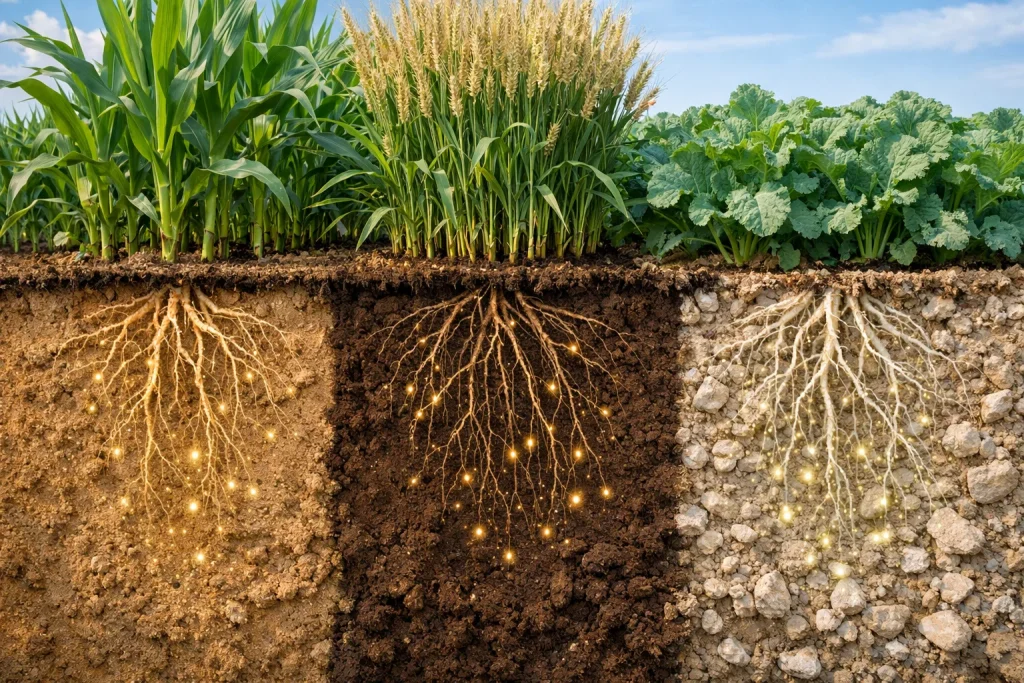
Under Special Soil Conditions
Certain soil types reduce nutrient uptake efficiency, such as:
- Sandy soils with high nutrient leaching
- Calcareous soils that limit nutrient availability
- Salinity-affected soils
Under these conditions, specialized fertilizers help compensate for soil limitations and improve nutrient uptake efficiency.
Benefits of Proper Use of Specialized Fertilizers
When specialized fertilizers are applied at the correct time and rate, they can deliver several benefits, including:
- Improved fertilization efficiency with reduced nutrient loss
- Faster plant response
- Enhanced fruit quality and size
- More stable and consistent yields
- Reduced need for repeated corrective applications
These benefits are only achieved when specialized fertilizers are used correctly and strategically.
Can Specialized Fertilizers Be Used Alone?
Specialized fertilizers are not a complete replacement for a balanced base fertilization program. Instead, they function as a supportive tool used when specific conditions require intervention.
Relying solely on specialized fertilizers without a structured fertilization program may lead to long-term nutritional imbalances.
The most effective approach is to integrate them within a comprehensive fertilization strategy based on:
- Soil analysis
- Crop nutrient requirements
- Different growth stages
Common Mistakes When Using Specialized Fertilizers
Some of the most common mistakes include:
- Using specialized fertilizers without a real underlying problem
- Applying excessive rates in an attempt to accelerate results
- Incorrect application timing
- Mixing incompatible fertilizers
Such mistakes can stress plants and produce negative outcomes instead of improvement.
How to Choose the Right Specialized Fertilizer
Selecting the appropriate specialized fertilizer should not be based on product names, but on a clear understanding of:
- The actual problem being addressed
- The plant growth stage
- Soil type
- Irrigation and environmental conditions
Referring to a well-structured fertilization program is always preferable to making isolated decisions.
Conclusion
Specialized fertilizers are precise agricultural solutions designed for use when specific needs arise, not for continuous application. When used at the right time and in the right context—especially when aligned with soil characteristics and soil type—they can significantly improve crop quality and productivity. However, improper use can lead to undesirable results.
A clear understanding of their role and limitations is the key to using specialized fertilizers effectively.