
Common Mistakes in Using Plant Growth Regulators (and How to Avoid Them)
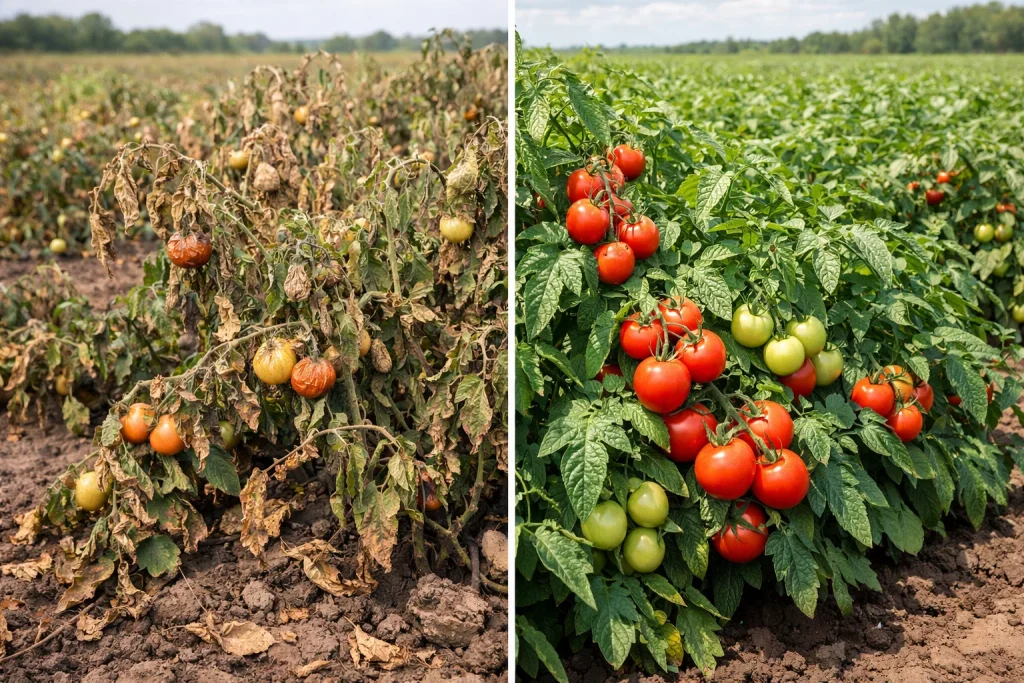
Why Do Plant Growth Regulators Sometimes Fail to Deliver Results?
Many farmers use plant growth regulators to improve yield or crop quality, yet in some cases the results are weak or unclear.
In most situations, the issue is not the product itself, but how it is used.
There are several common mistakes that directly affect the efficiency of plant growth regulators and their results.
Mistake 1: Using Growth Regulators at the Wrong Time
Timing is the most critical factor in determining success or failure.
What happens when this mistake occurs?
- Applying too early leads to weak impact
- Applying too late results in missed opportunity
The solution:
Use growth regulators according to the plant stage:
- Before flowering to stimulate growth
- During flowering to increase fruit set
- After fruit set to improve fruit size
Read:
When to use plant growth regulators: the correct timing for each stage
Mistake 2: Using Incorrect Dosage
Dosage plays a major role in determining results.
What happens when this mistake occurs?
- Excess dosage can stress the plant or deform fruits
- Low dosage may show no effect
The solution:
- Follow the recommended dosage
- Do not increase amounts to improve results
- Measure accurately
Mistake 3: Choosing the Wrong Type of Growth Regulator
Each type has a specific function, and using the wrong one leads to poor results.
What happens when this mistake occurs?
- No visible improvement
- Incorrect effect for the situation
The solution:
Choose based on the problem:
- Poor fruit set → use regulators that enhance fruit set
- Small fruit size → use regulators for enlargement
Read:
Types of plant growth regulators and the use of each in agriculture
Mistake 4: Spraying Under Unfavorable Weather Conditions
Weather conditions directly affect absorption and effectiveness.
What happens when this mistake occurs?
- Loss of a large portion of the product
- Reduced effectiveness
Examples of unsuitable conditions:
- High temperatures
- Strong winds
- Rain
The solution:
- Spray early in the morning or before sunset
- Avoid high heat and windy conditions
Mistake 5: Random Mixing with Other Products
Mixing growth regulators with other substances without proper knowledge can lead to unwanted reactions.
What happens when this mistake occurs?
- Reduced effectiveness
- Possible damage to the plant
The solution:
- Avoid mixing without knowing compatibility
- Consult an expert when needed
Mistake 6: Relying Only on Growth Regulators
Some farmers believe growth regulators can replace proper nutrition.
What happens when this mistake occurs?
- Weak results
- Failure to achieve the desired outcome
The solution:
- Ensure proper plant nutrition
- Use growth regulators as a support tool, not a replacement
Read:
Difference between plant growth regulators and fertilizers and their effects on plants
Mistake 7: Repeated Use Without Need
Overuse can stress the plant.
What happens when this mistake occurs?
- Plant weakness
- Negative results
The solution:
- Use only when needed
- Follow recommended frequency
How to Avoid These Mistakes
To avoid all the previous mistakes, follow these steps:
- Identify the problem accurately
- Choose the right type
- Determine the correct timing
- Use the correct dosage
- Apply the proper method
Read:
How to use plant growth regulators correctly (dosage and application methods)
Linking Mistakes to Results
If these mistakes are avoided:
- Fruit set improves
- Fruit size increases
- Crop quality improves
Read:
Best plant growth regulators for improving fruit set and increasing yield
Conclusion
Plant growth regulators are powerful tools, but their success depends on how they are used.
Simple mistakes can reduce effectiveness or produce negative results, so understanding and avoiding these errors is essential.

